
Stationary cryogenic tank – EasyBASE (FRDS)
Stationary cryogenic tank – EasyBASE (FRDS)
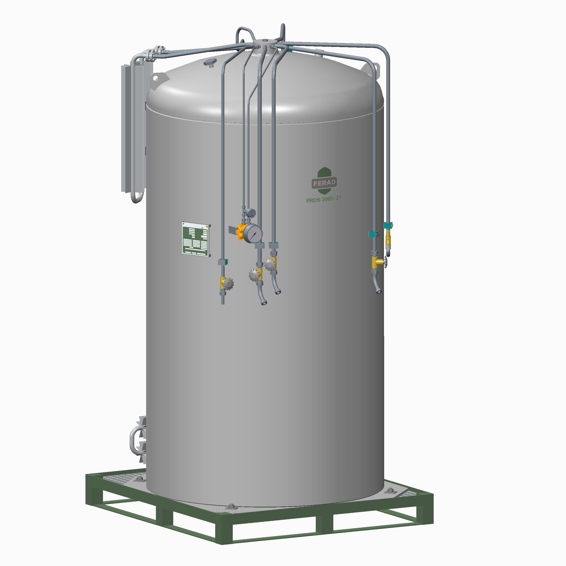
Click on a specific type in the menu on the left to get more information about specific products.
Cryogenic storage tanks are designed for storing liquefied gases at low temperatures.
Gas codes and groups:
3 A 1951 Argon, refrigerated liquid
3 A 1977 Nitrogen, refrigerated liquid
3 A 2187 Carbon dioxide, refrigerated liquid
3 O 1073 Oxygen, refrigerated liquid
3 O 2201 Nitrous oxide, refrigerated liquid
The high quality of our products is ensured, among other things, by a quality assurance system compliant with the ISO 9001:2015 standard. The storage tanks consist of an inner and an outer pressure vessel. The inner vessel is designed for the storage of cryogenic liquefied gases.
Minimum operating temperature for stainless steel vessels: -196 °C
Both the inner and outer vessels are manufactured from grade 1.4301 stainless steel in accordance with the EN 10028-7 standard. The inner vessel undergoes hydrostatic testing.
The quality of the outer vessel's welds is verified through helium leak testing, ensuring long-term vacuum integrity.
The inner vessel is insulated using a multi-layer insulation system.
The space between the inner and outer vessels is evacuated to a low pressure of 1 micron.
In addition, molecular sieve adsorption improves and ensures the long-term maintenance of the vacuum during the vessel's operation.
Ferad pressure vessels are units designed for gas supply in either liquefied or gaseous form. Depending on the specific approval, the maximum operating pressure ranges from 8 to 37 bar. An automatic control system helps maintain the set working pressure (pressure-building function) and minimizes losses during low-demand periods (pre-heater function).
Stationary vessels (FRDS) are fixed pressure vessels featuring vacuum and multi-layer insulation; they are designed and manufactured in accordance with the EN 13458-2 standard for the storage of cryogenic liquefied gases and are approved under the PED 2014/68/EU directive.
The vessel is protected by a robust metal frame that allows for safe transport, even when filled with liquid.
